
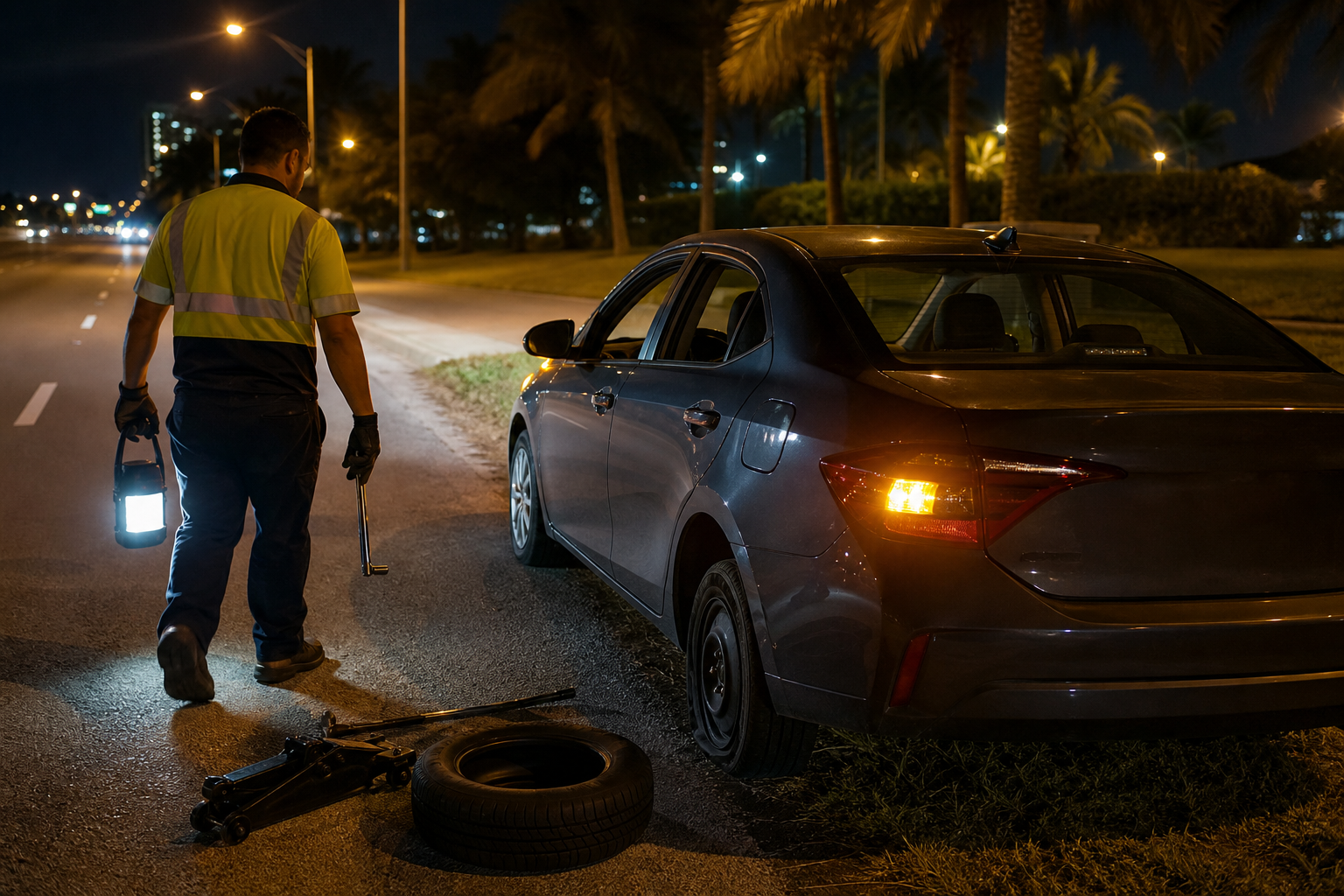
A flat tire after dark in West Palm Beach creates two separate problems: the damaged wheel and reduced visibility between you and passing drivers. Even if a spare or sealant might work mechanically, changing a tire beside moving traffic may expose you to more danger than the temporary fix is worth. Your first decision is not how quickly you can replace the tire. It is where you can stop without standing in an active lane or another unsafe area.
If the tire failed while you were moving
Do this now: Hold the steering wheel firmly, ease off the accelerator, avoid abrupt braking, and let the vehicle slow while you look for a safer stopping place. Turn on the hazard flashers. If the vehicle is already stopped where passing traffic comes close, keep your seat belt fastened and call for roadside help rather than stepping out to inspect the tire.
A loud bang, vibration, pulling sensation, or tire-pressure warning does not tell you by itself whether a temporary fix is safe. Use the situation matrix below only after the vehicle is stationary. Do not kneel near traffic or crawl under the vehicle to examine it.
Flat tire situation matrix
| What you see or experience | Temporary fix? | Best next step |
|---|---|---|
| A small tread puncture, no visible sidewall damage, wheel looks straight, and the vehicle is in a level area well away from traffic | Possibly, if the vehicle manufacturer permits the sealant or spare you have and you can work without entering the traffic side | Follow the vehicle and temporary-tire instructions exactly. If any condition is uncertain, request flat tire roadside service. |
| Tire is shredded, split, detached from the rim, or has a large opening | No | Do not use sealant. Request roadside evaluation and expect towing if a usable spare cannot be installed. |
| Bulge, cut, exposed cords, or other damage on the sidewall | No | The tire needs professional replacement rather than inflation or sealant. Arrange roadside help or towing. |
| Rim appears bent, cracked, scraped heavily, or no longer centered in the tire | No | A spare may not address wheel or suspension damage. Request towing and describe what you can see without approaching traffic. |
| Two or more tires are flat or damaged | Usually no | Most passenger vehicles carry no more than one spare. Ask for towing rather than trying to move the vehicle. |
| No spare, missing jack or lug wrench, locked wheel hardware without the matching key, or an unusable spare | No driver-installed fix | Call for roadside assistance and report exactly what equipment is missing. |
| Flat tire on the traffic-facing side, narrow shoulder, soft or sloped ground, darkness, or poor visibility | Not safely | Stay out of the roadway. Request help and explain the vehicle’s position so the provider can prepare. |
| Tire repeatedly loses air after inflation or sealant | No further temporary attempts | Stop driving. Continuing can destroy the tire, damage the wheel, and affect control. |
| A usable spare has been installed correctly and the vehicle feels stable | Limited travel only | Follow the spare’s marked restrictions and the vehicle manual. Go directly to appropriate tire service rather than resuming normal travel. |
Stop here or continue to a safer position?
Stop and call from where you are when:
- The vehicle shakes severely, pulls sharply, produces grinding sounds, or the wheel does not feel controlled.
- The tire has come apart or the wheel may be contacting the pavement.
- You would have to cross a live lane or stand close to passing vehicles to inspect or change the tire.
- You cannot identify a clearly safer stopping area ahead.
- Moving the vehicle would require driving at normal traffic speed.
If your position is exposed, remain seat-belted inside when that is safer than exiting. Keep the hazard flashers on, provide your location as accurately as possible, and tell the roadside provider that visibility or passing traffic is a concern. Do not stand between your vehicle and traffic, and do not wait directly in front of or behind the vehicle.
Move only far enough to reach a safer stopping place when:
- The vehicle remains controllable at a very low speed.
- A nearby level area away from moving traffic is clearly visible.
- Reaching it does not require a prolonged drive or crossing multiple active lanes.
- You can stop fully off the traveled path without blocking an entrance or creating another hazard.
This is not permission to “limp home” on a flat. Even a short drive on a deflated tire can turn a repairable puncture into tire and wheel damage. The only purpose of moving is to reduce immediate roadside exposure.
Continue after a temporary fix only when all checks pass
A spare or approved inflator is a bridge to tire service, not a return to ordinary driving. Before moving, confirm that the spare is secure, no tools remain under the vehicle, the tire holds pressure, and no damaged material rubs against the wheel. Follow every speed, distance, and loading restriction printed on the spare or stated in the vehicle manual. Stop again if vibration, pulling, noise, or pressure loss returns.
Roadside safety checklist
- Hazards on: Activate the vehicle’s hazard flashers as soon as control is stable.
- Choose space over convenience: Favor a level position farther from traffic, even if it is not the most convenient place to inspect the tire.
- Stay visible without entering the lane: At night, use the vehicle’s interior light briefly when communicating, but do not walk into traffic to place equipment.
- Keep passengers protected: Do not have passengers gather around the damaged wheel. Keep children and pets secured.
- Assess from a safe position: Note which tire is affected and whether it looks shredded or separated. Skip a close inspection when the tire faces traffic.
- Do not work under an unstable vehicle: A jack requires firm, level ground and the correct lifting point. Never place any part of your body beneath a vehicle supported only by a jack.
- Use only compatible equipment: Check the vehicle manual before using a spare, sealant, inflator, or jack.
- Escalate when conditions change: If visibility worsens, the vehicle shifts, or passing traffic feels too close, stop attempting the change and request roadside assistance.
Prepare the service call before help is dispatched
A clear description helps the provider decide whether to send equipment for a tire change or prepare for a tow. Have the following information ready:
- Your current location and the direction the vehicle was traveling.
- A safe callback number.
- Vehicle year, make, model, color, and drivetrain details if known.
- Which tire is affected: front or rear, driver side or passenger side.
- Whether the tire is merely low, fully flat, shredded, off the rim, or accompanied by visible wheel damage.
- Whether the vehicle has a spare, and whether it appears inflated and accessible.
- Whether you have the jack, lug wrench, and wheel-lock key.
- Any loading issue that may affect access to the spare, such as a full cargo area.
- Your safety conditions: nighttime visibility, narrow stopping space, nearby traffic, slope, or soft ground.
If there is no usable spare, more than one damaged tire, or possible wheel damage, say so at the beginning of the call. The appropriate solution may be flatbed towing rather than an attempted roadside tire change.
Need help deciding between a tire change and a tow?
Call with your exact location, vehicle description, affected tire, spare-tire status, and current safety conditions. That information allows the towing or roadside team to prepare for the actual problem instead of treating every flat as a routine tire change.
Flat tire roadside FAQs
Can tire sealant fix a blowout?
No. Sealant is intended only for certain small punctures in the tread area and must be compatible with the vehicle and tire. It cannot restore a shredded tire, damaged sidewall, separated bead, or bent wheel.
Should I change a driver-side tire next to passing traffic?
Not if the tire change would place you close to an active lane. Darkness makes both distance and driver visibility harder to judge. Stay in a protected position and request roadside help, clearly noting that the damaged tire faces traffic.
Can I drive slowly on the flat until I reach home?
Driving on a deflated tire can damage the tire and wheel while reducing vehicle control. Move only the minimum distance needed to leave an immediately dangerous position, and only if the vehicle remains controllable.
When does a flat tire require towing?
Towing is the safer choice when there is no usable spare, multiple tires are damaged, the wheel may be bent, the tire is shredded, the spare cannot be installed, or the vehicle still behaves abnormally after a tire change.
What if I cannot tell which tire is flat at night?
Do not circle the vehicle near traffic just to identify it. Give the provider the symptoms you felt, your vehicle position, and the fact that you cannot inspect it safely. The tire can be assessed when assistance arrives.